We have recently received a favorable judgment from High Court of Cassation and Justice in a case involving the illegal importation of goods bearing the HDMI brand. The infringing products were intercepted by customs authorities at the point of entry — once again confirming that infringement does not begin at the retail shelf, but at import, and that damage materializes the moment unauthorized goods enter the commercial circuit.
Beyond its practical relevance, the case offers an excellent opportunity to revisit a recurring debate under Article 13 of Directive 2004/48/EC on the enforcement of intellectual property rights.
Article 13(1) provides two formulations for assessing damages. Letter (a) refers to “all appropriate aspects,” including lost profits suffered by the rightholder and unfair benefit made by the infringer. Letter (b) allows damages to be set, in appropriate cases, on the basis of at least the amount of royalties or fees which would have been due had authorization been sought.
Too often, these are presented as alternative, separate, even hierarchically ordered methods. In reality, they are not.
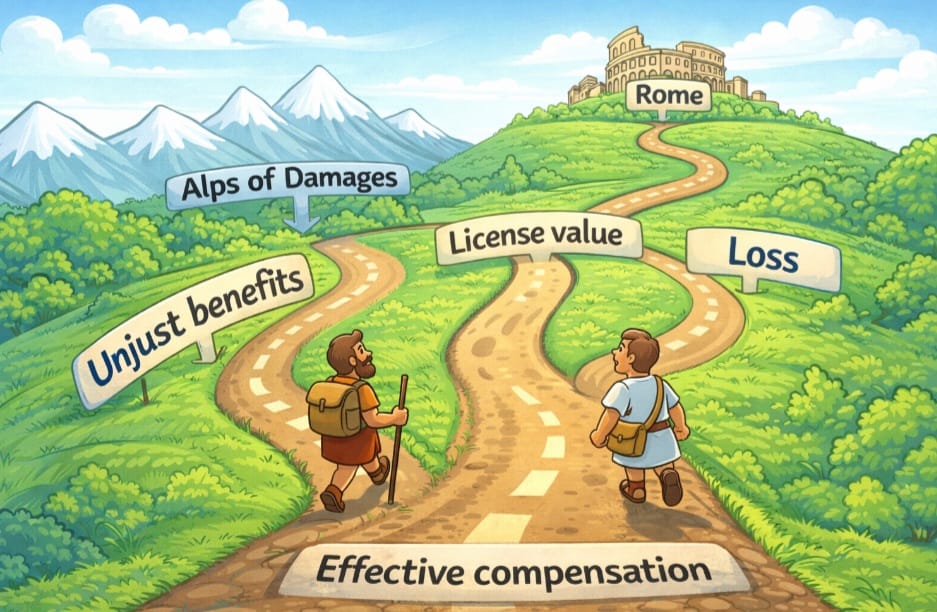
The Directive is clear in its spirit: damages must be compensatory, not punitive. The objective is neither enrichment nor sanction, but fair restoration of the actual harm suffered. If that is so, then all three conceptual elements — unjust enrichment, loss suffered, and the hypothetical license fee — are not distinct destinations. They are simply different roads. And all roads lead to Rome: the effective damage caused.
Letter (a) does not establish two autonomous methods; it identifies elements that may be taken into account in the assessment of harm. Likewise, letter (b) is not a subsidiary remedy to be used only when proof under letter (a) is difficult. Nor is it a “third way.”
In substance, letter (b) represents a floor — a minimum threshold below which compensation cannot fall. It reflects a simple economic truth: no infringer should ever pay less than what lawful access to the right would have cost. That amount is not a penalty. It is the irreducible material value of the unauthorized use.
In the HDMI case, the company operates under a transparent and publicly accessible licensing system. For that reason, we chose to claim the minimum license value as the baseline for compensation. Not because other heads of damage were unavailable, but because the license fee represents the lowest point of legitimate economic equivalence. Below that, compensation would cease to be compensatory.
Of course, that minimum does not exhaust the possible scope of damages. Additional elements may legitimately be added if proven – reputational harm, investigative costs, storage and transport expenses, legal fees, and other direct or indirect consequences of infringement. But the starting point remains the same: the infringer cannot be placed in a better position than a lawful licensee.
Seen from this perspective, Article 13(1)(b) should be reconsidered. It is not an alternative to letter (a). It is the expression of a lower boundary inherent in any rational estimation of damage. Whatever method is chosen, the assessment cannot descend below the price of legality.
All roads lead to Rome. And in IP enforcement, Rome is nothing other than the effective loss actually caused.